
The Confederates’ Shared Identity
William TellThis flow traces how stories of common origin and mutual duty become a political identity capable of resisting domination.
increasing Bearing strength in each event
 decreasing
Bearing strength in each eventdecreasingKinship Across Borders
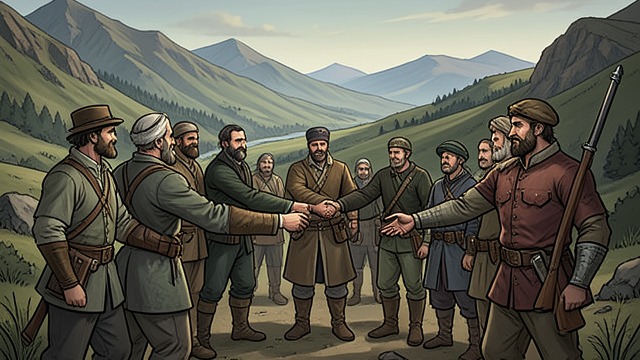
Kinship Across Borders
Divided geography
The delegates gather from communities separated by mountains, lakes, and local jurisdictions. Their political boundaries have never fully erased their sense of relatedness.
A remembered common origin
Werner Stauffacher recounts a traditional story of migration and settlement, presenting the cantons as branches of a shared historical community. The tale gives emotional force to the claim that their fates are linked.
The account matters less as a proof of exact descent than as a language of mutual recognition. The Confederates use it to make solidarity feel inherited as well as chosen.
The Oath as Bond

The Oath as Bond
An assembly made public to itself
The delegates swear not to separate in danger or death and to resist a return to servitude. Their vow gives force to the common identity described during the night.
Mutual defense
The oath is not simply a celebration of shared feeling. Each participant accepts an obligation to support the others, making private security depend on collective action.
The confederation is therefore created through both memory and commitment. The oath turns related communities into partners with responsibilities toward one another.
Rights and Duties Together
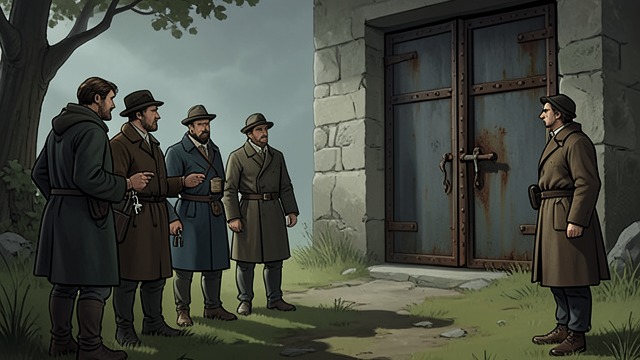
Rights and Duties Together
Self-rule without isolation
Werner Stauffacher argues that the cantons may govern themselves while acknowledging limited obligations to the empire. Their independence is not presented as a rejection of every wider authority.
The line against overreach
The delegates distinguish accepted service from the governors’ demands for unrestricted obedience. They intend to keep what is legitimately owed and reject what has been imposed without right.
This balance deepens the political meaning of freedom in the play. Autonomy is not portrayed as a refusal of all duty but as the ability to define lawful obligations within a just order.
The Hat as an Anti-Community

The Hat as an Anti-Community
Obedience made visible
Gessler’s hat requires every passerby to perform loyalty, converting an arbitrary object into a test of civic belonging. The command isolates each person and makes neighbors watch one another’s compliance.
Refusal becomes solidarity
When Tell passes without bowing, bystanders recognize that the rule exceeds legitimate authority. The ensuing confrontation draws townspeople and leaders together, even though they cannot safely prevent his arrest.
The episode shows how power tries to control public gestures as well as conduct. It also reveals how shared indignation can expose a community that had previously been kept apart by fear.
Freedom Extended to Serfs

Freedom Extended to Serfs
A limit exposed
During the rising, people from different social positions join the common effort. The alliance raises a question that political victory alone cannot answer: whether freedom belongs only to those already recognized as free.
A wider promise
At the ending, Rudenz declares that his serfs are free. His choice extends the meaning of the victory beyond the removal of the governors and into the social order of his own lands.
The play’s ideal of community is thus tested by inclusion. A free country remains incomplete if those living within it continue to bear hereditary bondage.
At the Rütli meeting
At dawn after the Rütli council
During the Rütli deliberations
Midway through the story, at Altdorf
At the final gathering
